














OnSite Computing is the hottest new way to use computers to do business: simple, direct access to information
and people no matter where you or they happen to be. It's simple because it uses standard Web browsers to
bring the universal Internet to your company's intranet. OnSite Computing means speed: you can do real work
from any location, and fast communication means having the competitive edge.
|
|

|
 AltaVista Directory 98: Reaching people wherever you are.
OnSite Registry allows you to locate and reach people instantly from the comfort of your Web browser. eXtend your enterprise with AltaVista Directory 98.
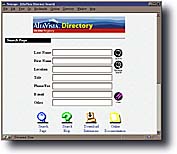 AltaVista Directory 98 is a new, open, client / server directory system designed to meet the unique requirements of doing business on the Internet.
The product promotes business communications by giving users and their applications quick and reliable access to the
contact information they need. AltaVista Directory 98 acts as an online address book and stores customizable information
about an organization and its members. This information can include member names, postal addresses, home and office telephone numbers,
electronic mail addresses, Internet web pages, etc.
AltaVista Directory 98 is a new, open, client / server directory system designed to meet the unique requirements of doing business on the Internet.
The product promotes business communications by giving users and their applications quick and reliable access to the
contact information they need. AltaVista Directory 98 acts as an online address book and stores customizable information
about an organization and its members. This information can include member names, postal addresses, home and office telephone numbers,
electronic mail addresses, Internet web pages, etc.
AltaVista Directory 98 provides a secure, centrally managed shared electronic directory to e-mail and Internet Web browsers.
AltaVista Directory 98 is accessed via standard protocols to users and applications across an organization's intranet and beyond.
AltaVista Directory 98 is Client Independent
Many different desktop clients can take advantage of AltaVista Directory 98 including:
Web Browsers
The AltaVista Directory 98 server provides access to directory information via the World Wide Web.
This means that any standard Web browser can be used to access AltaVista Directory 98 to search for
entries and display that information held in them. In addition, the directory can be configured so
that these Web browsers can be used to modify entry data within the directory. This allows users to
modify their own entries and thereby keep the information stored in the directory as up to date as
possible. It also reduces the need for centralized entry management personnel.
Mail Clients
MAPI
AltaVista Directory 98 provides a MAPI service provider component that can be used with any MAPI
capable client such as Microsoft Exchange clients, Microsoft Windows Messaging clients and Schedule +.
In each case, the address book facility in these products is extended to include AltaVista Directory 98.
as a shared address book resource available to any user on the network. This enables users to look up entries
from the "To:", "Cc:", and "Bcc:" fields of their mail client. AltaVista Directory 98 includes a
simple download mechanism to allow users to enable their favorite MAPI client to use AltaVista Directory 98.
This allows for an easy deployment of AltaVista Directory 98 throughout an organization.
LDAP
AltaVista Directory 98 is one of the first Internet applications to support the Lightweight Directory Access
Protocol (LDAP). LDAP is the standard directory protocol in use on the Internet. As a result of supporting
this protocol, other LDAP directory solutions can access AltaVista Directory 98.
ph and finger
AltaVista Directory 98 supports ph and finger Internet directory protocols. Any ph or finger client can
access AltaVista Directory 98 in order to search for entries and display the results found. AltaVista Directory
98 can interface with ph and finger supported applications such as Qualcomm Eudora Light and Qualcomm Eudora
Pro. These applications access AltaVista Directory 98 without any additional software components.
Management has been simplified
AltaVista Directory 98 was designed to be a very simple application to install and manage.
There are no configuration parameters that need to be set. And, installation of a
populated directory into AltaVista Directory 98 can be achieved in a very short period of
time.
Service management for AltaVista Directory 98 is integrated with the Windows NT service management
control panel. The server is managed in the same way as any other Windows NT service.
AltaVista Directory 98 provides a variety of applications to manage the data in the directory.
In order to manage your directory, you are able to quickly create, modify and delete entries.
Data administration components include:
- Directory Manager: Enables the creation, modification and deletion of any entry within
the directory. Attributes of entries are managed via easy to use property sheets. The
Manager is typically used by directory administrators to set up and maintain the directory.
- Web Browser: Any Web browser can submit modifications to the existing directory entries.
These entries are protected by an entry password. End users can use their favorite Web
browser to maintain their own entries.
- Tcl Extensions: Tcl extensions allow scripts to be written to import and export large
numbers of entries in single operations. These bulk loading scripts can be used to load
the directory from other data sources such as personal lists. Sample load and unload
scripts are provided with the product. Scripts can also be used to synchronize the
directory with other directories or databases. Tcl Extensions are designed to be used in
conjunction with the popular Tcl/Tk Tool command language.
State of the Art
AltaVista Directory 98 provides a database based on the Internet LDAP and X.500 standards.
This indexed database supports high performance searching and sophisticated matching. It
also includes approximate match capabilities based on the Soundex algorithm. The database
is held in main memory to ensure extremely fast response times that are demanded by today's
users.
Hardware and Software Requirements
AltaVista Directory 98 requires one of the following server component platforms:
- Microsoft Windows NT Intel V3.51
- Microsoft Windows NT Intel V4.0
- Microsoft Windows NT Alpha V3.51
- Microsoft Windows NT Alpha V4.0
Server systems require at least 16 Mbytes of system memory and at least 15 Mbytes
of disk storage space for the various binary and program files. Additional memory
and disk storage space may be required to support the directory information itself,
depending on the number of entries. As a thumbnail estimate, a typical directory
entry might occupy 2 Kbytes of storage. If a photograph is included with the entry,
the amount of storage requirements per entry will increase.
The client components are supported on all the above mentioned platforms and, in
addition, are also supported on Windows 95 running on Intel PCs.
A standard Web browser, such as Microsoft Internet Explorer or Netscape Navigator
can be used to access AltaVista Directory 98 from any platform.
Use of the AltaVista Directory 98 Tcl Extensions requires the installation of the
standard Tcl/Tk distribution, which is provided with AltaVista Directory 98.
|




